Daxton was a five-year-old autistic boy who was non-verbal, still in pampers, and had to be carried everywhere by his parents. No one ever expected his life to be completely changed by a little mare.
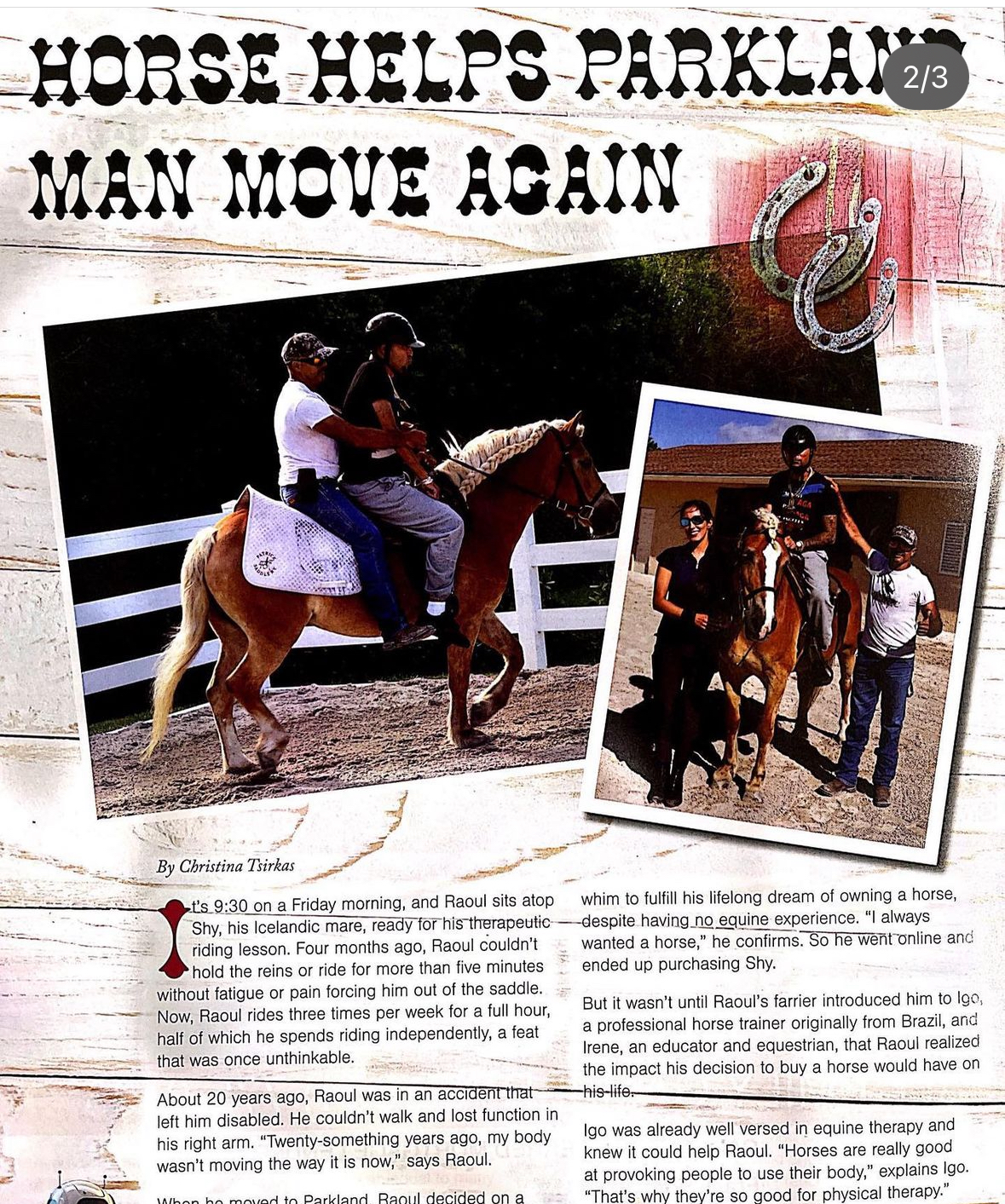
However, this healing journey began with a man named Raol and a horse named Shy.
A year earlier, Irene and Igo had worked with Raol after he lost the ability to walk and move normally. Through equine therapy, Raol found his way back into his body. Eventually, he began riding Shy on his own.
That alone would have been enough of a miracle. And the next part proves there is no such thing as coincidences: only destiny.
One afternoon, Raol’s neighbor called Irene and Igo. His grandson was visiting: a young boy named Daxton who had never shown interest in people, pets, or animals of any kind. His family had tried everything to connect him to the world.
But when Daxton saw Shy through the window, he ran toward the glass and stopped. He couldn’t take his eyes off her. He stayed there, glued to the window, as if something deep inside him had recognized something he needed.
Without understanding it, Daxton’s grandfather ran outside to speak to Raol and Igo, heard about Raol’s story, and contacted Irene. They explained that they couldn’t promise anything, but they were willing to try again.
And they knew exactly which horse they would bring.
Jude
Jude is an Arabian mare Irene and Igo had trained together—small, lanky, and deceptively powerful. She isn’t built for sport, but they realized she would be perfect for equine therapy.
They met Daxton at the Parkland arena with his parents and uncle. No one had expectations. They simply wanted to see what might happen.
Daxton’s mother explained that at home, they used counting to help him tolerate tasks—counting, then breaks. So they started small. The goal was simple: Daxton would touch Jude’s neck for one second.
Instead, his body flooded.
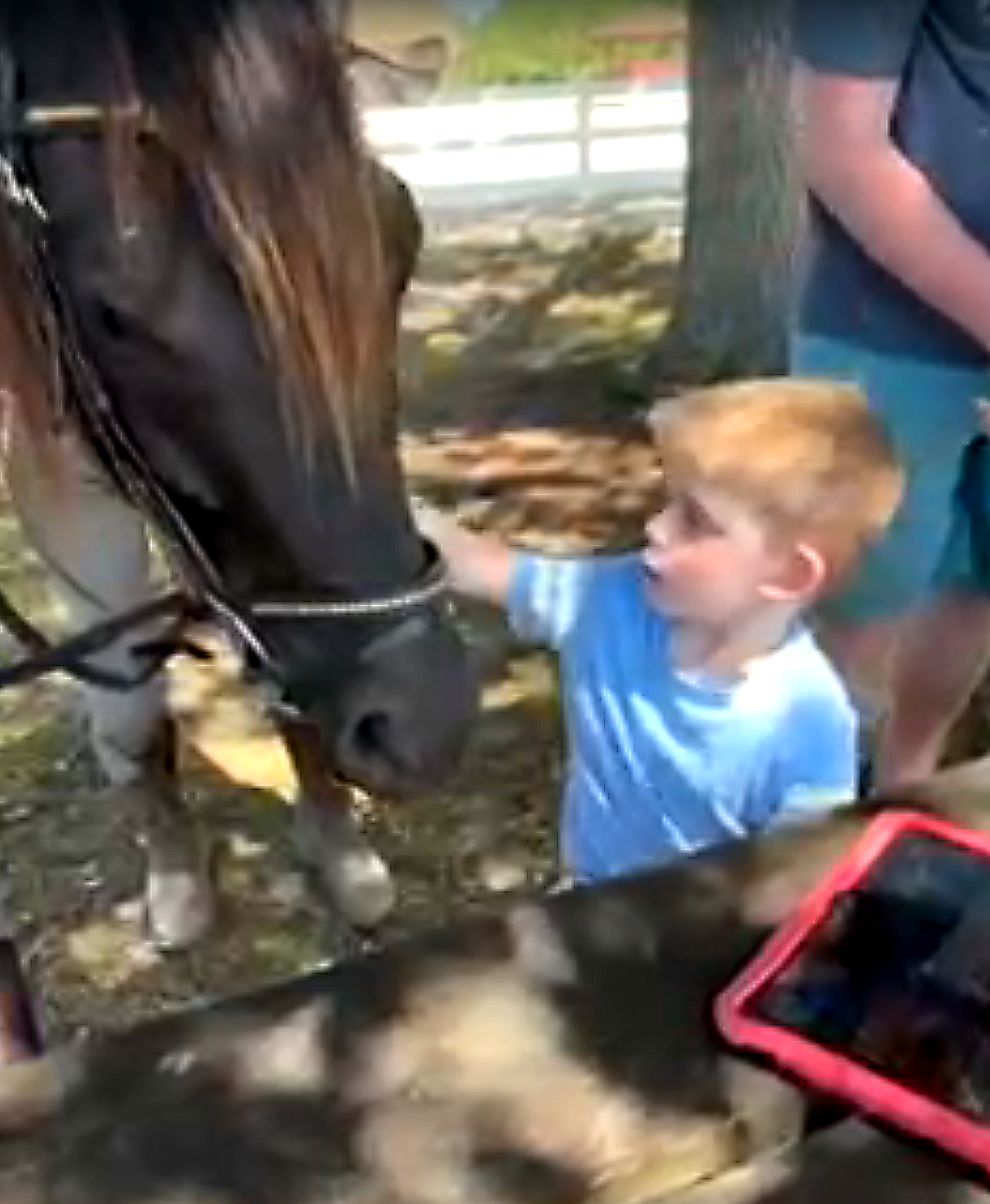
He screamed. He wanted to reach her, but he was overwhelmed by the stimulus. Irene took a strand of Jude’s mane and let him touch just that.
“Five seconds,” she said. “Then a break.”
He did it. Then he screamed and covered his ears, as if the experience itself had been too much to process. The session ended quickly. Irene and Igo exchanged a look. They both understood what they weren’t saying: this probably wasn’t going to work, but something told them to try again.
The second day was even harder. Daxton could tolerate touching Jude briefly, but nothing more. They tried sitting him on Jude with his mother for just five seconds, and the scream that came out of him was primal. Jude stood perfectly still and let him process it without moving a muscle.
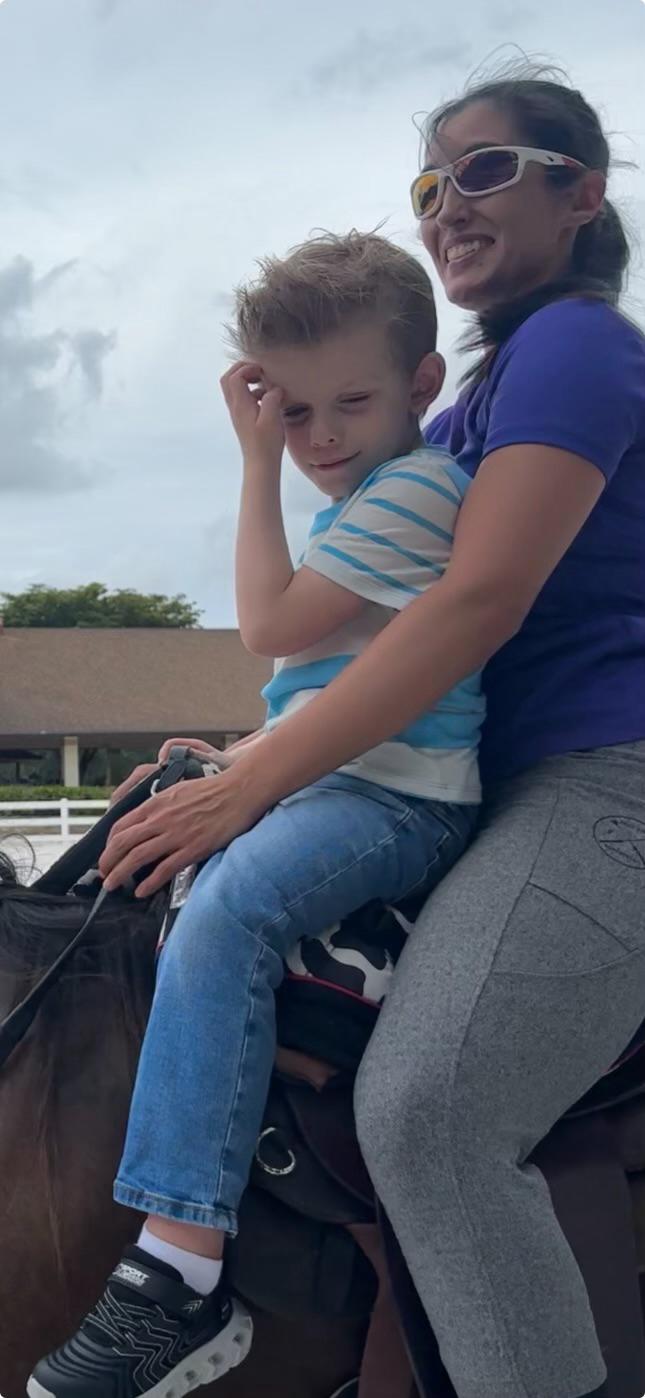
On the third day, there was an incredible breakthrough. Irene sat on Jude and placed Daxton on her lap, and his dad said, “Just ten seconds, and you get a break.”
At the count of ten, Daxton was screaming and covering his ears—but Irene noticed that he was smiling as his dad removed him from her lap.
The screaming wasn’t refusal. It was frustration. He wanted to stay on, but he could not communicate.
So Irene, an educator who works with children like him, said, “No one speak for him. I want to try something.”
She asked, “Daxton, Jude asks… how long would you like to sit on her?”
Daxton looked at her, then at his parents, then at Igo. The silence felt long. How could a non-verbal child reply?
Everyone stayed quiet.
Then he looked up at Irene, smiled, and said very clearly:
“Fifty-four seconds!”
Tears fell from everyone’s eyes. That moment changed everything.
.
What came next
From that point on, they stopped counting.
Counting had confused him. Instead, they gave him choices.
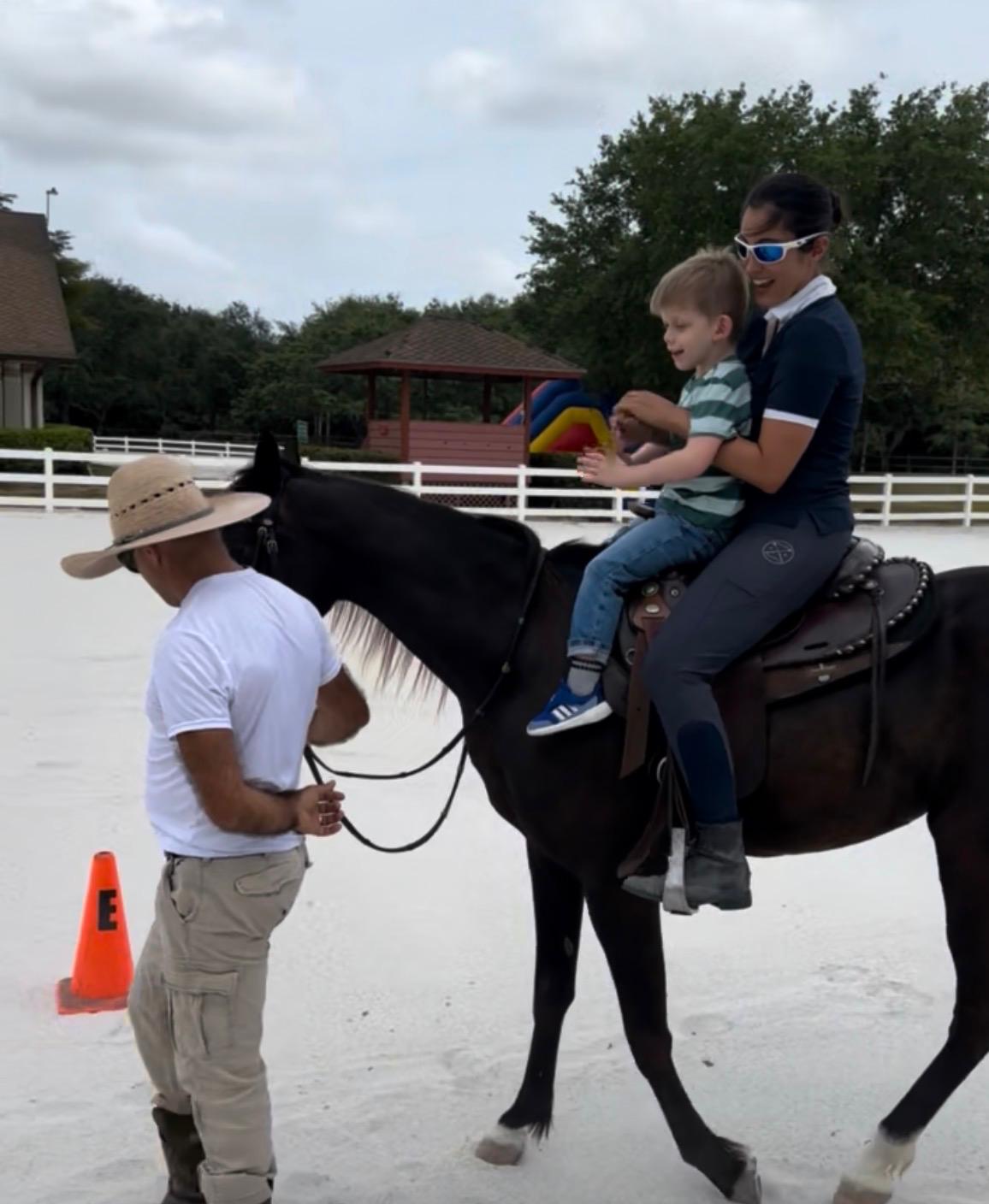
Irene and Igo set up cones in the arena with letters and pictures—something Irene had used many times in one-on-one reading intervention with non-verbal children, but never with a horse. Igo led Daxton on Jude while Irene sat behind him in the saddle.
“Hey, Daxton. This is Jude. We’re going to teach you how to ride her. She will go anywhere you want her to. You just have to tell her very clearly where to go. Watch me.”
“Jude, go to A,” Irene demonstrated as Igo led Jude to the letter A.
After repeating this with all the cones, it was Daxton’s turn.
He was silent for a while.
Finally, he pointed to a cone and, in a low, scared voice, said, “A.”
Irene smiled and said, “Jude has terrible hearing! You must speak loudly.”
Daxton shouted, “A, JUDE!”
Everyone smiled, and tears of joy fell. There were barrel races, high jumps, and high-level dressage rides happening all over the city—but this was the most magical ride in Parkland.
Daxton talks to jude
Over the next three months, Daxton and Jude worked together. His confidence grew.
They added math. Reading. Scavenger hunts. Problem-solving games clipped to Jude’s mane.
Daxton began speaking in full sentences—to Jude first, then to others.
He started folding his riding clothes the day before his Sunday lessons. He no longer needed his dad to carry him. Instead, he ran toward them saying, “My friends! Igo! Irene! Jude!” and threw his arms around them.
Gone was the scared child, trapped in his own bubble.
Daxton made friends at school, and his mom said, “The entire school knows about Jude, Igo, and Irene!”
His teachers had no idea Jude was a horse, but they were thrilled with his progress and joined in the effort. When Daxton was told that he needed to wear a helmet to ride independently, his teachers practiced helmet-wearing with him in class.
Today
Daxton is doing math.
He is reading.
He is starting kindergarten.
He will never need to wear pampers or be carried again.
Jude didn’t teach him how to speak.
She taught him that he was worth listening to.